Showing posts with label Kyoto. Show all posts

06 July 2016

Minister for Climate Change Issues Paula Bennett and the surplus emission units

A wee while ago, back on 23 May to be precise, I wrote an open letter to Minister for Climate Change Issues Paula Bennett calling on her to cancel the surplus Kyoto emission units held by the Crown.

I received an undated reply from Bennett on Monday 4 July 2016.

To crudely sum it up, Bennett's reply is "No we won't cancel any units. Those bad bad Ukrainian units! It was bad. But we stopped being bad, we won't bad again, at any rate no more bad than any one else!"

Here is the text of Bennett's letter. For reference, I have put the text of my open letter at the bottom of this post.

Thank you for your letter of 23 May 2016 about surplus Kyoto Protocol assigned amount units.

As you say, the Government has a surplus of 123.7 million Kyoto Protocol emission units which were left over after we retired units to meet our target for the first Kyoto commitment period.

I accept that there were up to 97 million Emission Reduction Units (ERUs) bought and surrendered in the New Zealand Emissions Trading Scheme (NZ ETS) before the Government stopped accepting them. That was within the rules, but we now know many of the ERUs are likely to have had poor environmental integrity. We are not accepting international units now, and we are working hard to make sure any international units traded in the NZ ETS in the future are of high environmental integrity. We are reviewing the NZ ETS to make sure it will be fit for purpose in the future.

As we have said in the past, we will meet our target of -5 per cent by 2020 using a combination of domestic abatement, forestry removals, and some international purchasing. There is information about the target on the Ministry for the Environment website at www.mfe.govt.nz.

We have not made a decision about what to do with any Kyoto units that are left over after we have met the 2020 target.

Nearly all other Kyoto developed countries also have surpluses. Some of them have said they will cancel units, but haven't actually cancelled them yet. There is no urgency to do anything with these units, and the fact that we are not cancelling them at this stage doesn't put us out of step with other countries.


Let's look a little harder at three statements in Bennett's letter.

  1. "We are not accepting international units now"
    Bennett is implying that the New Zealand Government made an express decision to stop the importing of some low-integrity international emission units. In fact, New Zealand ended up with no access to international carbon markets when Tim Groser told the UNFCCC that New Zealand was not going to have a formal emissions reduction commitment under the Kyoto Protocol for 2013 to 2020. Ms Bennett and the Ministry for the Environment should stop implying that some positive decision was made. Its just not true.
  2. "we will meet our target of -5 per cent by 2020 using a combination of domestic abatement, forestry removals, and some international purchasing."
    The translation of this spin back into plain language is 'we will still be using creative carbon accounting' to pretend we are reducing emissions when we know we are not. Bennett should really stop saying such a disingenuous statement. The Ministry for the Environment's 2020 Net Position Statement still explicitly shows the 123.7 million surplus units plugging the gap.
  3. "not cancelling them... doesn't put us out of step with other countries"
    Heaven forbid that New Zealand should be out of step with the many other countries who are also doing nothing about climate change!

My open letter to Paula Bennett - Your ethical duty to cancel 124 million surplus assigned amount units

Dear Minister,

I see that last Friday (20 May 2016) the Ministry for the Environment released New Zealand's Greenhouse Gas Inventory 1990–2014 and the summary 'Snapshot'.

I see that in the Snapshot summary on Figure 5, page 5, that New Zealand is still intending to use 123.7 million emission units (Assigned Amount Units or 'AAUs') that were 'surplus' from the Kyoto Protocol first Commitment Period to meet the 2020 emissions reduction target and still have a surplus of 92.6 million units.

You are aware that the Morgan Foundation's report 'Climate Cheats' and the Stockholm Environment Institute report (Kollmuss, Schneider and Zhezherin 2015) set out a persuasive case that the 97 million Emission Reduction Units ('ERUs') that were imported to New Zealand were “questionable or of low environmental integrity”. Those ERUs were surrendered by NZETS participants into Crown holding accounts.

According to the Kyoto Protocol 'True-Up' Report, in December 2015, the Ministry for the Environment cancelled (transferred Crown-owned units to cancellation accounts) 373 million emission units to comply with the Kyoto Protocol. The numbers and types of units cancelled were: the 97 million imported ERUs, 16 million imported Certified Emission Reduction units ('CERs'), 81 million removal units ('RMUs'), and 179 million AAUs . The 'surplus' units remaining in Crown holding accounts were 124 million AAUs.

In a nutshell, the only reason New Zealand (the Crown) has so many 'surplus' AAUs is because of the inflow and use of the dubious ERUs in the NZETS. Each dubious imported ERU has allowed one additional AAU to be carried forward in a Crown holding account as a 'surplus' unit. Because the ERUs have no credibility, the AAUs no longer represent carbon safely stored out of the atmosphere. No emissions were reduced. Therefore to use these surplus AAUs to comply with the national 2020 emission reduction target is simply an exercise in creative carbon accounting. It is simply unethical.

I put it to you that as Minister for Climate Change Issues, you are morally obliged to cancel these surplus units owned by the Crown. Will you cancel the units? It may hopefully to some small extent restore New Zealand’s very tarnished reputation with respect to mitigating climate change policy.

Yours sincerely

19 April 2015

Is it ‘doing our fair share’ to use creative accounting to meet New Zealand’s 2020 climate change target?

I look at how the National Government intends to use creative carbon accounting to ensure that New Zealand meets it’s 2020 climate change target (a five percent reduction) in spite of a projected trend of increasing emissions of greenhouse gases (GHG) to 2020.

On 10 April 2015, when he was releasing the latest inventory of greenhouse gases, the Minister for Climate Change Issues Tim Groser made this very confident statement; “We’re well on track to meet our 2020 target"

That target is to reduce greenhouse gas emissions to five per cent below 1990 levels by 2020.

When this was announced in 2013 the ambition (-5%) of the target was criticised as useless, pathetic and inadequate.

The five percent reduction stands in stark contrast to the Ministry for the Environments projections of increasing emissions out to 2020. The Ministry estimates that the increase in gross (total) emissions in 2020 will be 29% above the 1990 baseline (from 60 to 77 million tonnes) and the increase in net emissions (gross less any increase in the stock of carbon stored in forests) to 2020 will be 130% (from 33 to 75 million tonnes). So why is Tim Groser so confident that the target will be achieved?

Simon Terry of the Sustainability Council has commented on the ‘kicking the can down the road’ features of the Government’s climate change policies: the mismatch between the emissions target and the predicted emissions, the absence of a credible plan or carbon budget approach and the deferring of liabilities into the future.

Taking Simon Terry’s work as a starting point, I am going to look at how the Government intends to apply the accounting rules for carbon credits to achieve the 2020 target in spite of the likely predicted increase in gross and net greenhouse gas emissions.

So how is New Zealand going to reduce emissions by five percent by 2020?

In December 2014, at the climate change conference in Lima, Peru, our climate ambassador Jo Tyndall was asked that specific question. Her answer was that New Zealand was going to achieve the 2020 target and reduce emissions through a combination of four methods;

  1. domestic emissions reductions,
  2. removal of carbon dioxide by forests,
  3. participation in international carbon markets and,
  4. recognising surplus emissions units from the first commitment period of the Kyoto Protocol.

Domestic emissions reductions are unlikely. In 2013, Tim Groser told the Herald that his "strong advice" from officials was that the 2020 target could be met without any changes to settings of the New Zealand emissions trading scheme (or "ETS"). The relevant Cabinet Paper for the 2020 target also states that the 2020 target can be met without changing policies or ETS costs. In other words, the ETS will remain in its current induced coma, and stay ineffective in reducing domestic emissions.

New Zealand can’t meet the target by buying carbon credits from international carbon markets as access was blocked at the Doha meeting because we didn’t sign up to a formal Kyoto Protocol second commitment period target.

That leaves two ways of meeting the 2020 target; removal of carbon dioxide by forests, and recognising surplus units from the first commitment period of the Kyoto Protocol. I will look at the removal of carbon dioxide by forests next.

Forest carbon and Kyoto gross-net carbon accounting

By saying “removal of carbon dioxide by forests”, politicians and officials actually mean that carbon credits will be accounted for using the Kyoto Protocol’s gross-net forest carbon accounting rule.

This sounds innocuous, if a bit sleep-inducing. It is in fact a method of creative accounting that New Zealand has already relied on to meet the 2008-2012 Kyoto first commitment period target.

The 'baseline’, 1990 emissions, is “gross” - the sum of all emissions without subtracting any “credit” for carbon absorbed into sinks such as growing forests and land use changes. The target (2008 to 2012) emissions are “net", as credits for carbon absorbed in growing forests are recognised and are subtracted from the gross emissions. This is called gross-net accounting. This makes the comparison between baseline and target inconsistent - it is not an “apples with apples” comparison.

I have blogged on this before but Professor Martin Manning, an IPCC author and formerly of the Climate Change Research Institute at Victoria University of Wellington, explained it better in 2012.

"..achieving the Kyoto Protocol target can be quite misleading because it compares net emissions over the first commitment period, 2008 – 2012, with the gross emissions in 1990. If one compares the net emissions in 2012 with those for 1990, then the increase in New Zealand has actually been more than 100%."

The National Government intends to repeat this gross net accounting for the 2013 to 2020 target. As long as forest growth exceeds deforestation, this will allow both net and gross emissions to increase up to the quantity of carbon absorbed in forests that was ignored in the 1990 baseline.

The Climate Action Tracker website thinks the credit for carbon absorbed in forests could be up to 25 million tonnes CO2e a year and the ‘recognition’ (under Kyoto rules) of all the units would allow New Zealand's gross emissions to increase up to 35% above the 1990 baseline.

Surplus Kyoto units from first Commitment Period 2008 - 2012

Jo Tyndall’s final method of achieving the 2020 target is to recognise surplus emission units from the first commitment period of the Kyoto Protocol. According to the latest Ministry for the Environment net position statement for the Kyoto Protocol, New Zealand will finish the first commitment period (2008-2012) with a surplus of 90.8 million units.

Even though New Zealand has no formal 2013-2020 Kyoto ‘commitment’, New Zealand intends to ‘carry over’ millions of these surplus Kyoto units to the 2013-2020 period in accordance with the Kyoto Protocol rules.

The carry-over rules are of course complicated, but I calculate that NZ will be able to ‘carry over’ almost all of them - 86 million units of the various types of units (see final paragraph - Appendix ‘Carry-over’ of Kyoto first period units).

What’s wrong with having a surplus of units? An effective emissions trading scheme with a real cap would never have surplus units. Units would be scarce and realistically priced. A surplus of units is of itself evidence of a failed implementation of cap and trade frameworks such as Kyoto and the EU ETS.

A surplus of units is one consequence of emissions trading with no cap, unlimited access to international carbon markets and over-allocation of units to industry and a rock-bottom unit price. Which is exactly what we have had with the NZ ETS.

We need to remind ourselves why NZ has a surplus of units for the Kyoto Protocol first period. Although net and gross emissions increased, NZ gained surplus units by using the gross-net forest carbon accounting rule and allowing the nearly unlimited import of low-priced international units with dubious integrity which were surrendered by ETS participants to match their emissions.

According to Climate Analytics, internationally, the Kyoto first commitment period ended with 14 billion surplus units; enough to allow all the signatory countries to “comply” with their 2020 targets without restricting business as usual emissions growth.

And this is exactly what the Government intends to do.

Each Kyoto unit carried forward will be counted towards NZ’s 2020 target and will allow an additional tonne of domestic GHG emissions above the 1990 baseline.

Similarly, each carbon credit recognised for carbon absorbed in forests between 2013 and 20120 will be counted towards NZ’s 2020 target and will allow an additional tonne of domestic GHG emissions above the 1990 baseline.

Our politicians and bureaucrats could have focused on policies to reduce domestic emissions to meet the 2020 target. Achieving the 2020 target won’t be an outcome of policies to reduce emissions. Like fixing the emissions trading system. It will be an outcome of the accounting rules chosen for the carbon credits the Government can hold. That’s called creative accounting.

Appendix “Carry-over” of Kyoto first period units

The Kyoto Protocol has “carry-over” rules for unused units at the end of the 2008 - 2012 first commitment period. Some surplus units may be 'carried over’ to the second commitment period and then be used to comply with a country’s official commitment. Although NZ has not taken up a Kyoto second period commitment, NZ none the less intends to mimic the application of Kyoto rules designed to carry over surplus units from CP1 to CP2.

NZ will have a surplus of 91million units after transferring 378 million units to a cancellation account for the 378 million tonnes of emissions between 2008 and 2012.

There are limits on which and how many units can be “carried over”. All assigned amount units (AAUs) can be carried over; forest removal units (RMUs) cannot be carried over, carry-over of Certified Emission Reduction units(CERS) and Emission Reduction Units(ERUs) are limited to 2.5% of NZ’s initial assigned amount or 7.7 million each. See the UNFCCC Reference Manual

The Government will probably prefer to retire units that cannot be carried over in order to maximise the number it may carry forward.

On that basis, all 72 million RMUs will be cancelled, 37.3 millions CERs and 37.3 million ERUs will be cancelled, leaving 7.7 million each of CERs and ERUs carried forward. Then 231.4 AAUs need to be cancelled to make up to 378 million units.

The total carried over will be 86 million units composed of 7.7 million CERs, 7.7 million ERUs and 70.6 AAUs.

02 February 2013

John Key and Tim Groser on the wrong side of history - Kennedy Graham

Kennedy Graham gave a great speech in response to the annual Prime Minister's statement. This is the full speech

"Lord Nicholas Stern acknowledged just days ago that he had "got it wrong". Climate change is already far worse than he thought it would be only 6 years ago when he released his report."

"We are no longer likely to achieve the 2 degrees Celsius limit that the international community set for itself only 2 years ago. We are now on target for 3.5 degrees to 6 degrees. That takes us beyond the dangerous dimension of climate change, which the 1992 UN Framework Convention on Climate Change sought to prevent, and into what the World Bank calls "cataclysmic" climate change."

"What to say to a Government that in face of these developments guts its domestic climate legislation and refuses to enter a second binding international commitment period?"

"What to say to a Prime Minister who, in his annual statement to Parliament, omits climate change on the grounds that he touched on it last year?"

"What to say to a Minister for Climate Change Issues who says that New Zealand is ahead of the curve, that it is time to move beyond the Kyoto Protocol and join the largest polluters of the world, and who derides the global civil society when it criticises New Zealand for being one of the chief obstacles to progress at the UN conference in Doha?"

"We say this to John Key and Tim Groser. We say this: you are on the wrong side of history, both of you, in your respective ways."

Kia kaha, Kennedy!

16 January 2013

The Kyoto New Zealand break-up - when New Zealand said 'commitment' he never meant it

In this post I argue the best analogy for New Zealand's choice to opt out of a second commitment period (of reducing emissions) under the Kyoto Protocol - is: unfaithful men who won't commit to their partners!

New Zealand governments have behaved faithlessly towards Kyoto. The current National Government under Climate Minister Tim Groser won't commit to Kyoto stage 2. And the 1990s National Government gave a commitment they had no intention of being faithful to. New Zealand politicians and diplomats intentionally negotiated Kyoto so that New Zealand's Kyoto target would be met without reducing either gross or net emissions of greenhouse gases

I have argued before that New Zealand did not sign the Kyoto Protocol in good faith. As we seem unable to commit to Kyoto stage 2 in good faith, I have had another look at how faithful New Zealand's position was at the beginnings of Kyoto and at ratification in 2002.

According to a UNFCCC account of the Kyoto negotiations 'Tracing the Origins of the Kyoto Protocol: An Article-by-Article Textual History' on page 48;

"New Zealand was the only Party which made an early, more comprehensive proposal on the treatment of sinks, suggesting that sequestration of greenhouse gases from certain listed categories should be added to a Party's emission budget" (paragraph 226)
"New Zealand...faxed through a proposal for the treatment of sinks...sinks would not be included in a Party's baseline, but removals would be credited to a Partys budget (the so-called 'gross-net' approach)." (para 227)

(NB 'Sinks' meaning forests or land-use or land-use-change that sequesters carbon dioxide from the atmosphere. So the New Zealand diplomats were 'ahead of the curve' in negotiating to get forest sinks recognised so they could offset other emissions.)

In October 1997,three weeks before the UNFCCC meeting in Kyoto, Simon Upton, the Minister for the Environment in Jim Bolger's National Government said in a speech:

"New Zealand has long been advocating" for Kyoto rules where "removing carbon from the atmosphere in future years will earn us credits"

Let's look at the advice the Ministry of Foreign Affairs and Trade gave the government in February 2002, prior to New Zealand ratifying Kyoto that year. It was in a document called National Interest Analyses - Kyoto Protocol Part II

.
"New Zealand has an initial assigned amount for the first commitment period currently estimated to be 365 million tonnes of carbon dioxide-equivalent. That is, New Zealand is allowed to emit 365 Mt of carbon dioxide (or equivalent in other gases) over the years 2008 to 2012...New Zealand is expected to emit between 50 and 75 million tonnes over its 365 Mt initial assigned amount during the commitment period...."
"Current estimates are that, during the commitment period: New Zealand will emit between 415 million and 440 million tonnes of carbon dioxide equivalent, and New Zealand sink activities (derived from forests planted from 1990 onwards) will provide an additional 110 million units of assigned amount, in the form of removal units."
"At a national level, New Zealand is therefore expected to have a surplus of assigned amount over emissions of between 35 and 60 million units over the five years of the first commitment period."

MFAT were saying:
(1) New Zealand's greenhouse gas emissions would increase (not reduce) through to 2012.
(2) New Zealand would meet its Kyoto target by issuing itself additional forest sink removal units.
(3) New Zealand would make an economic gain from having a surplus of emission units.
So New Zealand would meet a 'trifecta' of Kyoto-related goals, none of which were reduced gross or net emissions.

MFAT were especially proud of that last point, making a profit. "New Zealand’s effectiveness in climate change negotiations means it is one of the few developed countries that stands to make a small net economic gain from the first Kyoto Protocol commitment period."

So what would MFAT's predicted increased emissions and forest removal units look like on a chart? Assuming the maximum 75 million tonnes of carbon dioxide equivalent greenhouse gases is represented by a linear increase of 0.94% p.a. from a base of 73 million tonnes in 1990, and the forest removal units are issued equally over 2008 to 2012, it looks like this.

This is what 'gross-net Kyoto accounting' of emissions and emission units looks like. From 1990 to 2007, gross or total emissions (blue dots) are the same as "Kyoto" emissions (the red dots). However, from 2008, you get the "Kyoto" emissions by subtracting carbon dioxide removed by 'human induced afforestation, reforestation and deforestation' (the violet dots) from the gross emissions. And the red dot Kyoto emissions suddenly dive under the 1990 baseline, even though both net and gross emissions have increased.

Except for the straight line, which is from my linear growth assumption, that looks very much like the current gross, net and Kyoto emissions, which I update below in a brand new animated 'Kyoto Escalator' chart

It's interesting to note that in the Ministry for the Environment's November 2012 calculation of the net Kyoto Protocol position, that although the ministry predicts a surplus of units (exceeding the target), this will happen in spite of an estimated 80% increase in annual net emissions since 1990 and a 27% increase in gross emissions. The actual gross and net emissions to 2010 have grown by 19% and 59% respectively, as shown in this chart

This is why whenever we hear Tim Groser or Nick Smith claim the New Zealand is meeting it's Kyoto target, we need to realise they are being the ultimate uncommitted unfaithful partner; in spite of their smooth rhetoric of caring about global warming, New Zealand's gross and net greenhouse emissions are showing an increasing trend. New Zealand needs to adopt policies that really do just stop emissions.

NB The original meme is Kyoto New Zealand break-up and all the images are at Picasa at Kyoto's Break-up with New Zealand where they can be viewed as a slide show. Feel free to use them and make up some more.

Kyoto's break-up with New Zealand at Picasa

I have just uploaded all the 'Kyoto's break-up with New Zealand ' images from the quickmeme website to Picasa

14 January 2013

New Zealand and Kyoto Protocol The break-up

I have made up a meme using a meme generator.

It's about break-up of New Zealand and the Kyoto Protocol.

They were a nice couple. They met back in the mid 1990s at the United Nations Framework Convention on Climate Change. They set an example for the rest of the world.

But..after five years, New Zealand broke up with Kyoto Protocol. Kyoto says New Zealand wouldn't give a second commitment...even though they set up an emissions trading scheme and a greenhouse gas emissions inventory together. New Zealand just didn't seem interested after the Durban Platform. Lately New Zealand is believed to be hanging around with Canada, the USA, and China

New Zealand just won't commit.

But we had an Emissions Trading Scheme together.

He's left me for China, India and the USA.

He's been so difficult since the Durban Platform.

I only asked him to reduce his net and gross emissions.

I only asked him to stop fiddling with his forest sinks.

The collection is called the Kyoto New Zealand break-up. It's been so much fun!

20 December 2012

New Zealand's double dealing and special pleading over the Kyoto Protocol second period and the Doha hooha Part 1

Is Tim Groser a Kyoto pariah? Or a Kyoto visonary? A global emissions reduction emissary or is he tar-sanded with a Canadian brush? I try to make sense of New Zealand's double dealing and special pleading over the Kyoto Protocol second commitment period and the Doha climate change talks hooha.

I am very confused about New Zealand's climate change policy since the Doha international climate change talks (COP18) and New Zealand opting out of a second period of the Kyoto Protocol back on 9 November 2012.

The Kyoto part two opt-out is described as a lose-lose decision that shuts New Zealand out of the Kyoto international carbon markets and is a shambles and a disgrace.

So I have a question for all you climate change blog readers.

If Minister of Climate Change Tim Groser is serious about New Zealand's 2020 greenhouse gas target, why would he forego formally lodging the 2020 target into the existing Kyoto Protocol framework (where the national institutions and arrangements are already up and running), in favour of pledging to meet the target on a voluntary basis?

Let me break that question down into several parts.

  1. Imagine you are the Minister for Climate Change in the government of a small developed nation.
  2. This nation has signed an international treaty with a few other nations which states a short-term national target for emissions of greenhouse gases (GHGs).
  3. This nation enacts the treaty by creating some new institutions; a national register for emissions units, national inventories of GHG emissions, national surveys of afforestation, and public servants to report the predicted progress towards the national target.
  4. The nation has adopted several policies relying on the treaty institutions; an emissions trading scheme, forest sink schemes, research alliances, and international trading of emissions units.
  5. The nation has a second publicly stated medium-term target for GHGs for the years following the expiry of the first target.

If you are serious about that second GHG target, why would you pledge the target on a voluntary basis, when you could have formally lodged your target into the existing treaty (where the national institutions and arrangements already exist)?

Any answers? Anyone? Would you like to phone a friend?

Okay, here's a hint. The Parliamentary Commissioner for the Environment has said that we are on track to exceed the 1990 GHGs baseline by 30% rather than meet the 2020 target of reducing GHGs by 10 to 20% compared to 1990.

Now just because New Zealand's net emissions are likely to consistently increase through to 2020 doesn't automatically mean New Zealand would not meet the 2020 target if translated into a Kyoto second commitment period target. We could just buy extra emissions units from the international Kyoto carbon markets.

That is, if there was a sensibly designed emissions trading scheme. Such a scheme would be 100% "emitter pays", with emitters making their own market-based decisions to either reduce emissions or to buy the emissions units. Well we certainly don't have that.

So my conclusion is that it is not just that Tim Groser has absolutely no intention doing anything domestically to achieve the 2020 target of a 10 to 20% reduction in GHGs. Groser and National also have absolutely no intention of imposing any real carbon price on New Zealand's industrial and agricultural emitters.

25 June 2012

Did anyone sign the Kyoto Protocol in good faith? The Kyoto Escalator shows that New Zealand certainly didn't

Robin Johnson's Economics Web Page introduces the Kyoto Escalator chart and argues that New Zealand was just as complicit as the major European countries in negotiating the Kyoto Protocol so that they complied with it without reducing either gross or net emissions.

Kyoto Escalator
New Zealand's Gross greenhouse gas emissions (blue) net emissions (brown) and 'Kyoto' emissions (red) 1990 to 2012. Double click on the chart to see it at 100% and in good resolution.

Professor Dave Frame is the new director of the Climate Change Research Institute at Victoria University of Wellington. He is a University of Canterbury-trained scientist who has worked for some years in Britain. He has just joined the climate change fray with a very interesting opinion editorial "International focus needed over climate" in the Dominion Post. Welcome to climate change issues back in New Zealand, David.

David Frame writes that New Zealand does not want to be thought of as the country that reneges on international treaties.

"Reputationally, accepting commitments and then failing to deliver on them is not a look New Zealand likes. "Doesn't honour the treaties it's signed" is not one of the few sentences we want people to remember about us."

So, yes, I agree, New Zealand should honour the treaties it signs. I hate to nitpick but, isn't New Zealand the country that was explicitly founded in 1840 on a treaty that was not honoured?

David Frame describes the history of the Kyoto Protocol climate negotiations

"...the Kyoto Protocol was a no-win situation for places like New Zealand. In the 1990s Britain and Germany were reducing their emissions of greenhouse gases for non-climate-related reasons (declining manufacturing and the collapse of the coal industry in Britain; technological substitution in the case of post-reunification Germany)."
"Kyoto's structure, reductions of emissions by some specific fraction compared with 1990 levels, were designed with this in mind, since it allowed Europe to appear to "take the lead" without actually doing anything very different from what they were going to do anyway. It was an approach so clearly aligned with the near-term reputational interests of some stakeholders that the Nobel prize-winning strategist Tom Schelling wrote of it: 'I cannot help believing that adoption of such a commitment is an indication of insincerity'."

Frame believes New Zealand's negotiators were innocent parties who acquiesced in these machinations while Britain and Germany portrayed themselves as "leaders" on climate change, even though their emissions reductions basically consisted of doing what they were going to do anyway.

While I am a little disappointed that Britain and Germany acted in such a self-serving way, I don't doubt that David Frame is correct about their motives. However, I don't think he is correct to say New Zealand was innocent. On 31 October 2007, the then Minister of Climate Change Simon Upton gave a speech about New Zealand's negotiating position three weeks before the UNFCCC meeting in Kyoto.

Upton stated that within New Zealand's negotiating position, using forest sinks to offset increases in emissions was just as important as the Protocol including international emissions trading, an all-gases approach and prompt acceptance of commitments by developed countries.

"Sequestration of carbon in sinks (such as forests) should qualify alongside emission reductions for the purposes of counting progress towards any targets that are agreed."

Upton contines.

"I want to say why sinks are important - spelling out in broad terms the economic benefits to New Zealand of counting sinks - and explain briefly how New Zealand considers they ought to be treated. Then I want to say why - even though the correct treatment of sinks is both fair in terms of the Convention, and good for New Zealand's economy - sinks nevertheless do not and cannot protect New Zealand emitters of greenhouse gases from adjustment."
"Adding to carbon stocks through afforestation should count positively; reducing stocks (through forest harvest, land clearance and such like) should count negatively."
"If - and I emphasise if - sequestration is treated in the way New Zealand has long been advocating, then the major contribution we expect to make to removing carbon from the atmosphere in future years will earn us 'credits'."

Upton and the New Zealand negotiators got what they wanted. Forest carbon sink credits were included as offsets. However, Upton provided several cautionary notes. If NZ's forest carbon credits were recognised in Kyoto, it may be perceived as special pleading. Also fairness suggested that forest owners should receive them, and be able to sell them. As opposed to the Government keeping them for compliance with Kyoto.

"New Zealand's stance on sinks has been treated with scepticism by some because, superficially, it looks as though it may be special pleading by New Zealand to take advantage of our sinks to reduce the pressure on emitters to make adjustments. We do not see it that way. New Zealand has been clear in responding to other countries that we do not see the accrual of sink credits as a way to insulate New Zealand from acting to reduce emissions. We see New Zealand's sink credits being an integral part of the international emission trading market. As such, we see New Zealand emitters facing the world price for carbon emissions provided that price is generated by a free market in emission permits."
"Let me now turn to a related question: why recognition of sinks nevertheless does not and cannot protect New Zealand emitters of greenhouse gases from adjustment. It might be suggested that New Zealand's interest in sinks stems purely from a desire to secure for itself a large buffer that would allow for significant growth in greenhouse gas emissions. That is not the case -- nor do I believe would it be credible to pursue such an objective."
"It would simply not be credible to advocate least cost tradeable mechanisms for the world and then seek to keep New Zealand's forest credits for domestic use only. Sequestration credits should accrue to the forest growers who earn them, and they should be free to place them on the world market."

So Simon Upton foresaw two problems with using the credits from forest carbon sequestration as a buffer to allow growth of GHG emissions. There was the reputational problem of New Zealand's insincere negotiating position in the Kyoto discussions. And there was the problem that the credits should accrue to the owners of the forests, not the Government.

New Zealand's climate change officials solved the "who's credits?" problem by inventing a new 'junk' currency to be issued to the commercial foresters instead of Kyoto units (and to buy off greedy emitters); the New Zealand Unit. The real Kyoto forest carbon removal units were kept "off the balance sheet". In the New Zealand Greenhouse Gas Inventory 1990 2009 and in the Kyoto Protocol net position report, the carbon sequestration from 2008 to 2012 is estimated from forest surveys. The actual Kyoto removal units will not be recognised until after 2012. It is these as-yet unissued units that offset the 19% increase in New Zealand's gross GHG emissions since 1990.

It seems since Simon Upton's time, we have developed collective amnesia about intentionally negotiating the Kyoto Protocol so that we could rely on forest carbon sinks to buffer increases in greenhouse gases. Has any one of the Kyoto Protocol parties negotiated and acted in good faith? New Zealand certainly hasn't

20 April 2012

The Kyoto escalator

I have just been experimenting with on-line gif animation.

Via an on-line service called Picasion

This is my New Zealand Kyoto Protocol escalator animation

gif maker
Picasion Gif maker

Possibly its a bit fast.

16 March 2012

Nick Smith 'punchs above his weight' in lukewarm climate policy denial part 1 - the NZ "Kyoto Escalator"

I introduce a 'killer' graphic to look at how Nick Smith is really a "lukewarmer", who - while saying he accepts the science of anthropogenic climate change, nevertheless denies the need to adopt any effective climate policy to reduce greenhouse gas emissions.

The worthy Kennedy Graham of the NZ Green Party recently tried to question Climate Change Minister Nick Smith in Parliament about the inadequacy of New Zealand's reduction targets for emissions of greenhouse gases.

Kennedy Graham, who does not seem to have read the Skeptical Science Debunking Guide, can be a bit verbose in his questions. He describes the debate as "apocryphal". Which ties in my previous theme that debates about climate change politics can quickly degrade into jargon and 'yada yada' that cause MEGO. And this is the definition of flogging the dead horse and swallowing of the elephant in the room.

Nick Smith seems to be aware of this as he typically discusses climate change policy using short catchy "public-relations" sound bites. For example:
I can absolutely assure the member that this Government takes those international negotiations very seriously. I have to say that this House should be very proud of the contribution of the Minister responsible for those international negotiations. Tim Groser is playing a very pivotal role and this country is punching well above its weight in ensuring progress is made.
I would also point out that New Zealand is going to comfortably meet its Kyoto obligations around emissions.

So New Zealand is the real Kiwi battler, "punching above its weight", in terms of climate change policy!! Really. Really? Really!

Smith's specific example is complying with the Kyoto Protocol. For New Zealand, the Kyoto 'outcome' is average greenhouse gas emissions between 2008 and 2012 ('the commitment period') and the 'target' is the 'baseline' of gross emissions in 1990. New Zealand must manage the 'outcome' (2008 to 2012 GHG emissions) so that it meets the 'target' - the 1990 'baseline'.

New Zealand must either reduce average 2008-2012 greenhouse gas emissions to the 1990 volume x 5 years or obtain other Kyoto-compliant emissions units to match the growth in emissions.

The Ministry for the Environment says New Zealand will not just meet the Kyoto target we will probably exceed it by 21 million emissions units.

In reality, according to New Zealand’s Greenhouse Gas Inventory 1990–2009 New Zealand's total (or gross) GHG emissions increased from 1990 to 2009 by 19%. Net emissions (after subtracting forest sequestration) increased by 23%.

So why is Nick Smith saying we comply with Kyoto? Let us recall that New Zealand's ease in complying with the Kyoto Protocol is because of the forests loophole.

The NZ Kyoto 1990 baseline/target is defined as gross emissions - that is without deducting carbon sequestration in forests. The 2008 to 2012 Kyoto 'outcome' emissions are defined as gross emissions less Kyoto compliant emissions units recognised for carbon sequestration in forests after 1990.

Okay that was a bit yada yada. Feeling a bit MEGO?

As an antidote to MEGO here's the Kyoto escalator. Imitating the Skeptical Science temperature escalator it is an animated chart for the New Zealand Kyoto forest loophole. Click on it for a larger version. The chart shows firstly gross GHG emissions in green from 1990, actual to 2008 and projected to 2012. Clearly an increasing trend. Then net emissions after carbon sequestration by forests in blue. Also an increasing trend. Then "Kyoto" accounting of GHG emissions - gross to 2007, then net from 2008 to 2012.

Back In 1997, another National Government Minister for Climate change, Simon Upton, said that New Zealand's climate change policy would lack credibility if New Zealand's interest in forest sinks appeared to be all about gaining a large buffer to allow for significant growth in greenhouse gas emissions. Obviously Nick Smith has no such concerns.

14 December 2011

Canada gives notice to Kyoto Protocol

Canadian Andrew Leach blogs on Canada's announcement of its intention to withdraw from the Kyoto Protocol and the enforcement and penalties issue.

Leach is also in the Globe and Mail.

He confirms that there would be no financial penalty if Canada stayed in the Kyoto Protocol for the first commitment period but do not sign and ratify for the second commitment period. By withdrawing, Canada becomes a 'non-participant' not a 'non-compliant but unpenalised' participant of the Kyoto Protocol.

Or as Leach says "the key reason [for withdrawing] is...to avoid an explicit finding of non-compliance – the analog which immediately jumps to mind is a student dropping a course they are likely to fail".

30 November 2011

Unlike the UNFCCC climate change negotiations, Neville Chamberlain only went to Munich once

In which I discuss the Durban UNFCCC international climate negotiations through a historic lense of the Second World War and the Rio 1992 Earth Summit.

In a very considered comment on the Hot Topic blog , David Lewis questions whether the Durban UNFCCC international climate negotiations can come up with a binding treaty that effectively reduces GHG concentrations, given the existing public will.

"I don’t see how negotiations on an international climate treaty can proceed to an agreement that would actually stabilize the composition of the atmosphere at a level that would not cause [dangerous anthropogenic interference] without more demand for such an agreement coming from the global population"
.

David Lewis compares the global demand for action in the international climate change negotiations with the changing British attitudes to 'Total War' with Hitler's Germany in 1940. Lewis implies that in the climate change negotiations, each government is "trapped in a circumstance where it can’t generate the national will that’s necessary".

In terms of the purposes served by international climate change negotiations, I would go a step further than that thoughtful comment from David Lewis. I say that the negotiations have never had the goal of producing a binding treaty to stabilise greenhouse gas concentrations. Governments instead use the negotiations as one of their reasons for not reducing emissions of greenhouse gases and for continuing with 'business-as-usual'.

Let me summarise my contention using another reference to the Second World War.

Q. Whats the difference between Neville Chamberlain's negotiations in 1938 with Hitler in Munich that lead to the annexation of Czechoslovakia and the UNFCCC international climate change negotiations?
A. Neville Chamberlain only went once to Munich.

In making my argument I am influenced by a paper my late father Robin Johnson wrote in 1992 about the political-economy of the Rio Earth Summit. Robin uses the term "political-economy" to indicate he is considering the various groups with interests in the Earth Summit and asking what interests were served by the outcomes.

Robin noted that the expected outcomes of the Rio Earth Summit were binding signed international conventions on climate change and biological diversity. However, the actual outcome was a "framework convention...full of resounding phraseology and generalities".

Robin says the reason for this outcome was the fundamental split between the 'North' (developed countries) and South (developing country) blocs. Neither bloc was was willing to put global interest ahead of national interests. Instead, the outcome of the Earth Summit consisted of "non-binding language ... adopted to get all major nations to sign".

No agreement except on non-binding rhetorical statements! Sound familiar, doesn't it? Isn't that whats happened with all the subsequent climate change talks?

Robin's paper uncannily predicts much of the next 19 years of inconclusive negotiations. He wrote "Prior to meeting in Rio, some governments expressed concern that the Earth Summit would become a "pledging conference" where world leaders would be expected to step to the podium and announce their country's contribution." Copenhagen 2009, anyone?

Robin concluded "The challenge for those seeking action will be to channel the outcomes of Rio into concrete action by member states". Substitute "Bali 2007" or "Copenhagen 2009" or "Cancun 2010" for "Rio", and we can re-use that conclusion for all subsequent international climate change negotiations.

So, from a political economy point of view, the climate change negotiations have had the effect of ensuring that international opinion stays "behind the demand curve” for decisive action. After all, that is the function they have served in the 19 years since the Rio Earth Summit in 1992.

So I think we need to let go of the idea that the negotiations as they are currently constituted and conducted will make any useful contribution to the kind of decisive international action that is required. We need to accept that the negotiations are just another forum for business and politics as usual.

09 August 2011

How to chart the NZ Kyoto Protocol commitment

The post about Dr Nick Smith's junk chart has been on Hot Topic NZ, the Oil Drum Oz and NZ and hat-tipped on No Right Turn

Okay, so what would a good chart of New Zealand's greenhouse gas emissions and New Zealand's compliance with the Kyoto Protocol look like?

We mulled over that issue last year when we wrote a how to book on carbon forests.

I came up with this chart as a first draft.

Clunky and black and white. Add colour.

Paul Kennett said "hmmmm" and asked me for the data and he came up with this.


Not surprisingly, Paul's version appeared in the published version of The Carbon Forest (available now at the Kennett Bros!)

02 August 2011

The NZ ETS Review 2011 and the Minister's Chartjunk

This evening I was intending to carefully read the Report on the New Zealand Emissions Trading Scheme that Minister for Climate Change Issues Nick Smith released today and write a considered review.

However, I only got as far as Nick Smith's forward on the the third page when I got stopped in my tracks by Figure 3, a misleading piece of chartjunk if I ever saw one, about New Zealand being on target to meet its obligations under the Kyoto Protocol. Here it is.
The chart legend says it shows "Kyoto net emissions (actual emissions)". This parameter trends upward to 2007 and then in 2008 and 2009 it suddenly drops below the blue line of NZ 1990 emissions. Thus showing we are meeting our emissions reduction commitment that we signed up in the Kyoto Protocol. Its enough to make you proud to be a Blue-Green.

This chart is junk because it misrepresents the underlying data on greenhouse gas emissions. Back to the legend: "Kyoto net emissions (actual emissions)". Why does it say "actual emissions" in brackets? Because Smith would like you to think that. Lets look at a real chart of real New Zealand greenhouse gas emissions.

This shows total real emissions up to 2007 and predicted emissions 2008 to 2012 - the green line. It looks nothing like Fig 3. The actual and predicted trend does not show a return to 1990 volumes of emissions. However, that legend also said net emissions, that is total or gross emissions in any year less carbon absorbed by forests. Maybe Fig 3 is based on net emissions.


The trend in net emissions (total less forest sink removals) or the blue line shows an even steeper rate of increase than the total emissions. So how can Fig 3 show that New Zealand reduced emissions to 1990 volumes? Two more clues are in Figure 3. The title is "Kyoto net" and there is a note under the data source says "Kyoto net 2000-2007 values are backcasted". So the Fig 3 data is not just "net", it is also "Kyoto net" and "backcasted". What does ''backcasted" mean? Another chart shows how Smith gets to Fig 3 from the real total and net emissions data.


Greenhouse gas emissions, as defined for compliance with the Kyoto Protocol, are gross from 1990 to 2007, and once the Kyoto commitment period starts in 2008, an Annex B country like New Zealand can meet its target by deducting removal units issued for carbon sinks - so Kyoto-defined emissions go net from 2008. Hence the red line. The removal units issued for afforestation (the increase in carbon stock in a forest planted since 1990) appear as if from nowhere in 2008 and disguise the growth in both the gross and net emissions.

This isn't new information. In 1997, Simon Upton, the Minister for Climate change in Jim Bolger's 1990's National Government spoke of New Zealand's position at the UNFCCC talks; "if sequestration is treated in the way New Zealand has long been advocating, then the major contribution we expect to make to removing carbon from the atmosphere..will earn us 'credits' ".

Interestingly, Upton had this cautionary note: "It might be suggested that New Zealand's interest in sinks stems purely from a desire to secure for itself a large buffer that would allow for significant growth in greenhouse gas emissions". Upton believed that would not be a credible policy.

However, since Upton's day, the chartjunk that is Figure 3 indicates that New Zealand's climate change policies have consistently been all about providing exactly that buffer to allow for significant growth in greenhouse gas emissions while claiming to have mitigation policies such as the NZ ETS that match our much-abused clean green overseas image.

11 February 2011

Smith's Gross Error on Net 1990 GHG emissions

Speaking of gross Kyoto confusion, Nick Smith has leapt in to the media fray to defend his view of the Kyoto Protocol and to say that the Greens Russell Norman has got his numbers wrong in his press release.

Smith says Norman is wrong and "tricky, misleading and mischievous" to say that net 1990 emissions are 31 million tonnes less than gross 1990 emissions. Smith says the difference is 1 million tonnes.

Unfortunately it is Smith that has made the Gross error.

In the forth paragraph, Smith states:
New Zealand’s emissions in 1990 were 60.9 million tonnes gross and 61.7 million tonnes net under the agreed Kyoto Protocol rules.
Umm no, according to MfE (April 2010) New Zealand’s Greenhouse Gas Inventory 1990–2008, Report No ME 1009, by the Ministry for the Environment, ISSN 1179-223X.

Page iv states "In 1990, New Zealand’s total (or gross) greenhouse gas emissions were 60,773.6 Gg carbon dioxide equivalent (CO2-e)". (60.7 million tonnes)

Page v states "In 1990, New Zealand’s net greenhouse gas emissions were 29,707.3 Gg CO2-e." (29.7 million tonnes, and certainly not 61.7 million tonnes as Smith's release states)

(NB Gg = gigagrams and 1000 Gg = 1 million tonnes)

Here's the chart again! Nick Smith, have a good look at where the green and blue lines leave the lefthand vertical axis!


Does the Minister's office even understand GHG inventory reports from the Ministry for the Environment?

Kyoto Protocol decoded

The Kyoto Protocol has been mentioned in the NZ blogosphere over the last day or so. No Right Turn describes New Zealand's actions to comply with our obligations under the treaty as Scam Writ Large. He is largely commenting on a Green Party press release from Russell Norman, where Russell critiques Nick Smith's 50% reduction in GHGs by 2050 target.

Russell Norman's point is that the Government target for 2050 is an "accounting trick", as the 1990 baseline is total or gross GHG emissions from industrial and domestic energy use and pastoral farming excluding carbon sequestration from the forestry sector (carbon sinks). The 2050 target will be net, after deducting carbon sink removals. Therefore the "trick" is comparing a net target with a gross baseline. That allows gross emissions to have grown by any amount up to the additional 'credit' from the carbon removals from growing forestry.

No Right Turn agrees and adds that the same Gross-base-net-target fudge also fully applies to the Kyoto Protocol commitment period of 2008 to 2012.

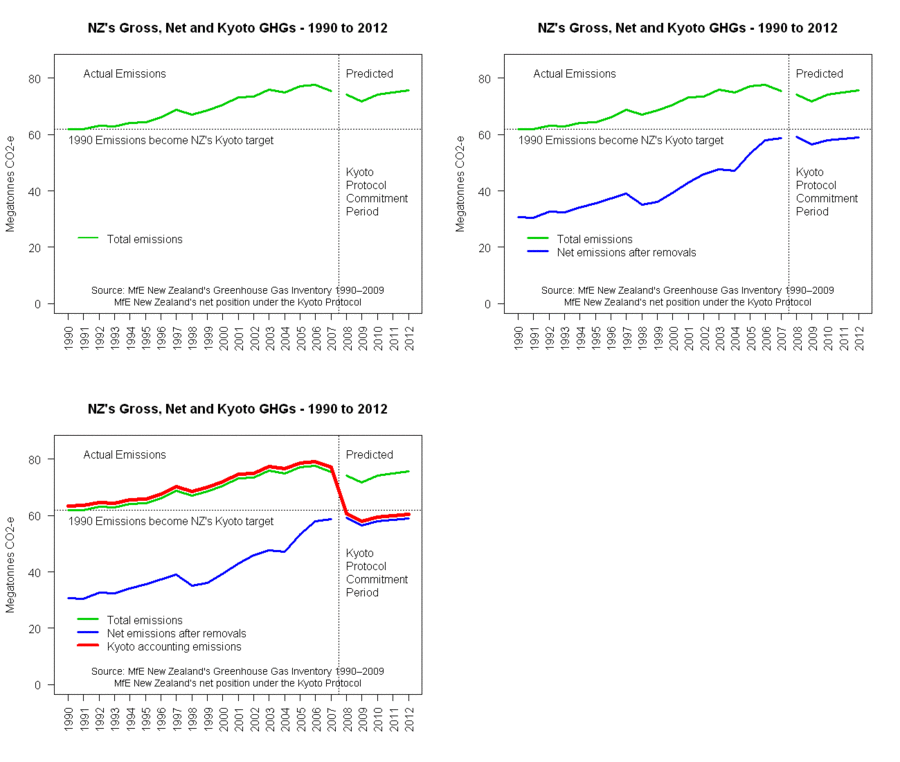
This gross-net distinction is a bit hard to understand. So I have done some charts that will hopefully explain this in the context of the Kyoto 2008 to 2012 period. The first is just total emissions of greenhouse gases in NZ for 1990 to 2008.


Remember, NZ's Kyoto obligation is "no increase on 1990 levels of GHGs" so there is a horizontal line at 61 million tonnes (61 megatonnes), the annual GHG emissions calculated for 1990. Well, its obvious the trend line is not returning to the 1990 level. Okay, lets add the net GHG emissions, the gross GHGs less the forestry carbon sink removals.
Heck, those net emissions have grown faster up to 2008 even more than the gross emissions! So, how on earth is New Zealand going to get the GHG emissions back to 1990 levels to comply with the Kyoto Protocol? Nick Smith has told us that NZ will not just meet the Kyoto target but will be in a surplus.
The red line in this third chart shows the "Kyoto accounting" of NZ emissions. The forestry sink carbon removals, from 1990 to 2007, are ignored and have no status; the base in 1990 is gross GHGs only. Then, magically, from 2008 to 2012, the forestry sink carbon removals suddenly are counted and may be awarded as carbon credits to "post 1990" forest owners. Thus every carbon credit issued to a forester balances out the increase in gross emissions of GHGs above the 1990 base.

Hence, from these charts, I agree with both No Right Turn and the Greens that the Kyoto Protocol is very flawed from the point of view of driving reductions in GHG emissions.