22 April 2012

Helter smelter - NZ Aluminium Smelters/Rio Tinto Alcan NZ wins the 2011 Roger Award

Robin Johnson's Economics Web Page reports that NZ Aluminium Smelters/Rio Tinto Alcan NZ have just won the 2011 Roger Award for Worst Transnational Corporation operating in Aotearoa/New Zealand "for milking the NZETS".

Every year the group Campaign Against Foreign Control of Aotearoa (CAFCA) awards a Roger Award for bad multinational corporate behavour.

Past winners have been Warner Brothers for the Hobbit film employment law change and British American Tobacco.

Readers may recall I wrote some posts about the excessive allocation of free emissions units from the NZ Emissions Trading Scheme to NZ Aluminium Smelters/Rio Tinto Alcan NZ.

I concluded that in 2010 the Rio Tinto Alcon NZ received 135% more emissions units than it needed for its greenhouse emissions, as an undisclosed amount of units were to compensate it for undisclosed ETS-related electricity costs.

In other words, Rio Tinto Alcon NZ would pay a higher 'carbon' price if it was exempt from the NZ ETS, as they would at least be paying some 'carbon' price as a 'downstream' electricity user.

I rewrote the analysis from those posts and wrote to CAFCA nominating NZ Aluminium Smelters/Rio Tinto Alcan NZ for a Roger Award.

Well, the winner was announced on Saturday and it is..........NZ Aluminium Smelters/Rio Tinto Alcan NZ! I quote from the judges report.
  1. New Zealand Aluminium Smelters Ltd (NZAS) has effectively undermined the purposes of the carbon emissions trading scheme...
  2. NZAS has already been secretly compensated for any electricity price increases associated with the emissions trading scheme...
  3. NZAS were provisionally allocated 423,047 New Zealand Units for 2011...
  4. the New Zealand taxpayer is subsidising a transnational corporate rort of the emissions trading scheme.
  5. NZAS has, effectively, abrogated any responsibility to mitigate the incidence of anthropogenic global warming... a major transnational player within New Zealand materially benefits from its non-compliance with a strategy to reduce global climate change...
And,
Of course, this raises fundamental questions about the efficiency of emissions trading, as compared to a tax-based model directed toward the largest CO2 emitters.
I couldn't agree more. This is only a summary. The whole 26-page Judges report (PDF) is well worth a read. It includes a seven page history of the 'Comalco' smelter company that includes details of NZETS lobbying. There is also a ten-page analysis by Sue Newberry of the NZ Aluminium Smelters/Rio Tinto Alcan NZ finances and multinational corporate structure.

I leave the concluding point to the Judges.
With both Labour and National governments in thrall and with Greenhouse Policy Coalition lobbyists closely involved in the design and implementation of the ETS, it was only to be expected that Comalco/RTA would be at the head of the queue for its free handouts of emission units...Its milking of the Emissions Trading Scheme is entirely in character.  
Helter Smelter!

20 April 2012

The Kyoto escalator

I have just been experimenting with on-line gif animation.

Via an on-line service called Picasion

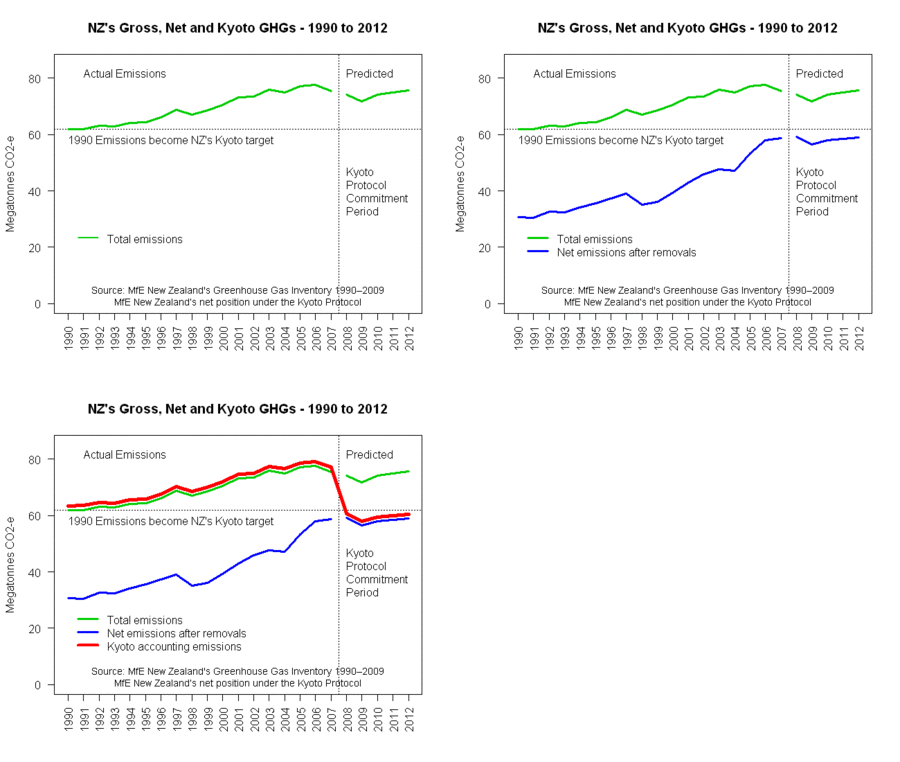
This is my New Zealand Kyoto Protocol escalator animation

gif maker
Picasion Gif maker

Possibly its a bit fast.

16 March 2012

Nick Smith 'punchs above his weight' in lukewarm climate policy denial part 1 - the NZ "Kyoto Escalator"

I introduce a 'killer' graphic to look at how Nick Smith is really a "lukewarmer", who - while saying he accepts the science of anthropogenic climate change, nevertheless denies the need to adopt any effective climate policy to reduce greenhouse gas emissions.

The worthy Kennedy Graham of the NZ Green Party recently tried to question Climate Change Minister Nick Smith in Parliament about the inadequacy of New Zealand's reduction targets for emissions of greenhouse gases.

Kennedy Graham, who does not seem to have read the Skeptical Science Debunking Guide, can be a bit verbose in his questions. He describes the debate as "apocryphal". Which ties in my previous theme that debates about climate change politics can quickly degrade into jargon and 'yada yada' that cause MEGO. And this is the definition of flogging the dead horse and swallowing of the elephant in the room.

Nick Smith seems to be aware of this as he typically discusses climate change policy using short catchy "public-relations" sound bites. For example:
I can absolutely assure the member that this Government takes those international negotiations very seriously. I have to say that this House should be very proud of the contribution of the Minister responsible for those international negotiations. Tim Groser is playing a very pivotal role and this country is punching well above its weight in ensuring progress is made.
I would also point out that New Zealand is going to comfortably meet its Kyoto obligations around emissions.

So New Zealand is the real Kiwi battler, "punching above its weight", in terms of climate change policy!! Really. Really? Really!

Smith's specific example is complying with the Kyoto Protocol. For New Zealand, the Kyoto 'outcome' is average greenhouse gas emissions between 2008 and 2012 ('the commitment period') and the 'target' is the 'baseline' of gross emissions in 1990. New Zealand must manage the 'outcome' (2008 to 2012 GHG emissions) so that it meets the 'target' - the 1990 'baseline'.

New Zealand must either reduce average 2008-2012 greenhouse gas emissions to the 1990 volume x 5 years or obtain other Kyoto-compliant emissions units to match the growth in emissions.

The Ministry for the Environment says New Zealand will not just meet the Kyoto target we will probably exceed it by 21 million emissions units.

In reality, according to New Zealand’s Greenhouse Gas Inventory 1990–2009 New Zealand's total (or gross) GHG emissions increased from 1990 to 2009 by 19%. Net emissions (after subtracting forest sequestration) increased by 23%.

So why is Nick Smith saying we comply with Kyoto? Let us recall that New Zealand's ease in complying with the Kyoto Protocol is because of the forests loophole.

The NZ Kyoto 1990 baseline/target is defined as gross emissions - that is without deducting carbon sequestration in forests. The 2008 to 2012 Kyoto 'outcome' emissions are defined as gross emissions less Kyoto compliant emissions units recognised for carbon sequestration in forests after 1990.

Okay that was a bit yada yada. Feeling a bit MEGO?

As an antidote to MEGO here's the Kyoto escalator. Imitating the Skeptical Science temperature escalator it is an animated chart for the New Zealand Kyoto forest loophole. Click on it for a larger version. The chart shows firstly gross GHG emissions in green from 1990, actual to 2008 and projected to 2012. Clearly an increasing trend. Then net emissions after carbon sequestration by forests in blue. Also an increasing trend. Then "Kyoto" accounting of GHG emissions - gross to 2007, then net from 2008 to 2012.

Back In 1997, another National Government Minister for Climate change, Simon Upton, said that New Zealand's climate change policy would lack credibility if New Zealand's interest in forest sinks appeared to be all about gaining a large buffer to allow for significant growth in greenhouse gas emissions. Obviously Nick Smith has no such concerns.

09 March 2012

The Science is Clear - new James Hansen talk from TED 2012

I have just found this recent 2012 TED talk by James Hansen. It has been on-line since 7 March. The number of views on TED is 120,748 today. The number of views on Youtube was 13,473. I bet that rises.


The talk is very polished. Hansen reads from a script and has obviously run through the talk several times. Hansen discusses the natural greenhouse effect, the Earth's energy imbalance caused primarily by fossil fuel combustion, sea-level rise, species extinctions, impacts on agriculture and the need to act for the benefit of future generations as represented by his grandchildren.

01 March 2012

Climate change denier Bryan Leyland as a "must read"? Has Bryce Edwards jumped the shark?

I usually enjoy reading the usually thoughtful opinions of Otago political scientist Bryce Edwards of the Liberation blog. Since the 2011 election Bryce Edwards has written a daily column in the New Zealand Herald. But in his column of 27 February 2012, Bryce Edwards endorses an opinion piece by climate change denier Bryan Leyland as a "must-read item for the day".
"For those interested in issues of inequality (and the environment), the must-read item for the day is Brian Leyland's "The only way is full steam ahead". Leyland makes the case for the necessity of both economic growth and technological innovation in order improve not just the interest of society as a whole, but to reduce inequality and protect the environment".
Really. Really! Really?

Bryan Leyland is one of New Zealand's premier deniers of anthropogenic 20th century climate change. Leyland was a foundation member of New Zealand's American-funded deniers organisation - the New Zealand Climate "Science" Coalition.

Has Bryce Edwards lost it? Has he jumped the proverbial shark? Has he succumbed to media savviness under the pressure of having to provide a daily political column?

Bryce Edwards should be aware that climate contrarians like Leyland enjoy a media platform out of proportion to their expertise;
"media-savvy individuals with outlier views on climate change can be disproportionally represented in the national news media regardless of the level of their expertise".
I don't know, but I have just lost some confidence in the opinions of Bryce Edwards.

16 January 2012

James Hansen at 5min.com

I have just seen a new source of online videos of James Hansen. The website 5min.com is also free of the advertisements that seem so pervasive at You Tube these days.

14 December 2011

Canada gives notice to Kyoto Protocol

Canadian Andrew Leach blogs on Canada's announcement of its intention to withdraw from the Kyoto Protocol and the enforcement and penalties issue.

Leach is also in the Globe and Mail.

He confirms that there would be no financial penalty if Canada stayed in the Kyoto Protocol for the first commitment period but do not sign and ratify for the second commitment period. By withdrawing, Canada becomes a 'non-participant' not a 'non-compliant but unpenalised' participant of the Kyoto Protocol.

Or as Leach says "the key reason [for withdrawing] is...to avoid an explicit finding of non-compliance – the analog which immediately jumps to mind is a student dropping a course they are likely to fail".